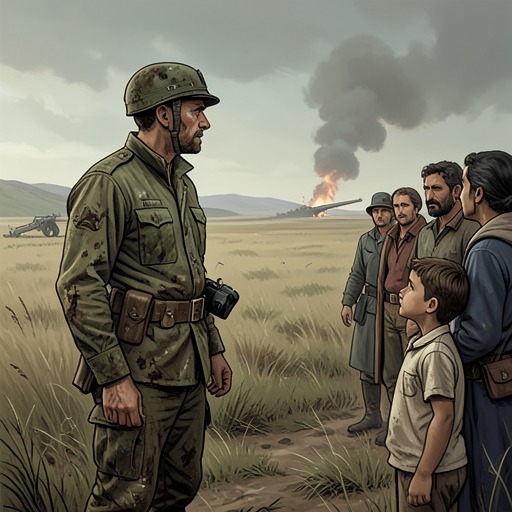
Uncle Toby’s aid to Lieutenant Le Fever
The Life and Opinions of Tristram Shandy, GentlemanUncle Toby’s aid to Lieutenant Le Fever is a scene of compassion made practical: hearing that an unknown former soldier is gravely ill at a village inn, Uncle Toby supplies what comfort he can, sends Corporal Trim to learn more, and receives the corporal’s account of the sick man’s devoted son. The assistance begins with drink and toast, but its deeper movement is from uncertainty about a stranger to an expanding circle of concern, in which the sufferer, his child, the landlord’s household, Trim, and Uncle Toby are joined by sympathy.
The appeal from the inn
One evening, as Uncle Toby sits at supper, the village innkeeper enters carrying an empty phial and asks for a glass or two of sack for a poor gentleman, apparently a soldier, who has been ill at his house for four days. The man has scarcely raised his head or wanted food; only now has he asked for sack and a thin toast, saying that they might comfort him. The appeal is modest, but the innkeeper makes clear that the need is urgent: if he could not beg, borrow, or buy the drink, he would almost steal it for the patient.
Uncle Toby answers not by questioning whether an unknown guest deserves help, but by recognizing the innkeeper’s kindness and extending it. He gives the innkeeper a glass to drink the sick man’s health, sends two bottles with his compliments, and offers a dozen more if they will do the patient good. His generosity is immediate and open-ended: the first gift meets the request, while the promise of further bottles makes the comfort available for as long as it may help.
The details of the report enlarge the circle of concern. The landlord says that he and his whole family are worried for the stranger. Uncle Toby is struck by how quickly the guest has won their affection and asks Trim to discover his name. The landlord has forgotten it, but returns with the more consequential information that the patient has a son, a boy of about eleven or twelve who has barely eaten and has remained at his father’s bedside for two days, mourning night and day.
Uncle Toby’s response and Trim’s mission
When the landlord describes the boy’s vigil, Uncle Toby lays down his knife and fork and pushes his plate away. The gesture interrupts the ordinary business of supper: attention has shifted from his own meal to the needs of a family he has never met. Trim silently removes the plate and, a few minutes later, brings his master pipe and tobacco. The scene allows concern to gather before Uncle Toby speaks again; after lighting his pipe and smoking, he asks Trim to stay.
Uncle Toby eventually reveals his plan: because it is a bad night, he is thinking of wrapping himself warmly in his roquelaure and visiting the sick gentleman. Trim objects on concrete grounds. The garment has not been worn since the night before Uncle Toby received his wound while they mounted guard in the trenches before the Gate of St. Nicolas, and the cold, rainy weather could aggravate the torment in his groin. The old wound is not incidental background; it makes the proposed visit a choice that might cost Uncle Toby dearly.
Uncle Toby admits that the risk troubles him, yet he is not at rest since hearing the landlord’s account. He wishes either that he had known less, or that he had known more, and asks how they should proceed. Trim offers to go instead, carrying his hat and stick to reconnoitre the house and promising a full account within an hour. Uncle Toby entrusts him with the task and gives him a shilling to drink with the sick man’s servant. Concern is thus converted into delegated action: Trim can investigate without exposing his injured master to the wet night, while Uncle Toby remains prepared to provide further help.
The son and the recognition between soldiers
The narrative pauses over Uncle Toby’s pipes before Trim returns, preserving the episode’s characteristic delay and conversational rhythm. By the time he has knocked the ashes out of his third pipe, the corporal is back from the inn. Uncle Toby asks whether the patient is in the army and what regiment he belongs to; Trim begins again from the beginning, promising to relate matters as he learned them. Uncle Toby fills another pipe and asks him to sit in the window-seat and speak without interruption. This patient listening gives the report room to unfold rather than reducing it to a bare account of a sick stranger.
At the inn, Trim has heard that the patient’s purse was given to his son to pay the man who could hire horses, but the landlady doubts the gentleman will ever leave. She says she heard the death-watch all night and fears that the boy, already broken-hearted, will die when his father does. These are the household’s apprehensions, not a confirmed outcome. Trim then encounters the son in the kitchen, where the boy has come to order the thin toast for his father and insists on preparing it himself.
Trim offers to take over the task and gives the boy his chair by the fire, but the youth believes he can please his father best by doing it himself. Trim reassures him that his father will not like the toast less for having been made by an old soldier. The boy takes Trim’s hand and bursts into tears. The contact and the tears communicate what the boy cannot readily put into words: the soldier’s identity has made him recognizable as a possible friend in the midst of fear. Uncle Toby interprets the response through the boy’s upbringing, supposing that the name of a soldier has sounded in his ears like the name of a friend because he has been bred in the army from infancy.
Trim confesses that he has never felt such a desire to cry in company, not even during the longest march, and wonders what could be the matter with him. Uncle Toby answers that nothing is wrong: Trim is a good-natured fellow. The exchange turns the corporal’s tears from a lapse requiring explanation into evidence of fellow-feeling. The boy’s grief has crossed the distance between stranger and soldier without argument or formal introduction; the narrator’s emphasis is on a recognition enacted through a hand taken, tears shed, and a shared sense of what a soldier’s presence can mean.
Assistance as a shared undertaking
After making the toast, Trim tells the boy that he serves Captain Shandy and that his master, though a stranger, is deeply concerned for his father. He offers anything available in Uncle Toby’s house or cellar. Uncle Toby adds that Trim might also have offered his purse, extending the corporal’s message into a more explicit promise of material aid. The boy bows deeply, an acknowledgment meant for Uncle Toby, but cannot answer because his heart is full; he carries the toast upstairs to his father.
The scene contrasts this practical kindness with the curate of Mr. Yorick, who is smoking by the kitchen fire but says nothing to comfort the youth. Trim judges the silence wrong, and Uncle Toby agrees. The contrast is not between elaborate religious doctrine and an opposing doctrine; it is between a bystander’s silence and the attention expressed through food, shelter by the fire, an offer of resources, and emotional presence. The episode measures compassion by what people do when another person is ill and frightened.
Uncle Toby’s assistance therefore extends beyond the initial bottles of sack. He entrusts Trim to investigate, offers hospitality from house and cellar, makes his purse available, and places himself in relation to the patient’s son through the corporal’s explanation. Trim, in turn, does not merely collect information: he helps prepare the toast, gives the boy a seat by the fire, offers reassurance, and brings his grief back into the parlour as a story that moves his master. The aid is distributed among them, each action making room for the next.
Narrative significance
The episode presents Uncle Toby’s characteristic benevolence as active but not heedless. He wants to visit despite the danger to his old wound; Trim’s loyal warning does not extinguish that impulse, but redirects it into reconnaissance and assistance that can be given without risking the same physical cost. The master’s compassion and the corporal’s care for their master work together, so that service is neither blind obedience nor solitary heroism.
The telling also makes sympathy appear contagious without treating it as an abstract virtue. The innkeeper’s concern reaches Uncle Toby; the landlord’s account of the boy’s vigil makes him put aside his supper; the boy’s tears move Trim; and Trim’s report brings Uncle Toby’s judgment and resources into the story. The chain is marked by concrete objects and gestures—the empty phial, bottles of sack, the untouched plate, the pipes, the shilling, a chair by the fire, and the thin toast. Each object carries concern from one person to another.
The scene ends not with a reported recovery or a resolved crisis, but with a distinction in conduct: the youth receives tangible and emotional attention from the Shandy household’s circle, while the curate remains silent. By keeping the patient’s fate open in this episode, the narrative centers what can be known and done at this moment: an ill stranger is treated as worthy of help, and his son is not left alone with grief. Uncle Toby’s aid matters because it turns compassion into a sequence of choices, shared among people who began as strangers.